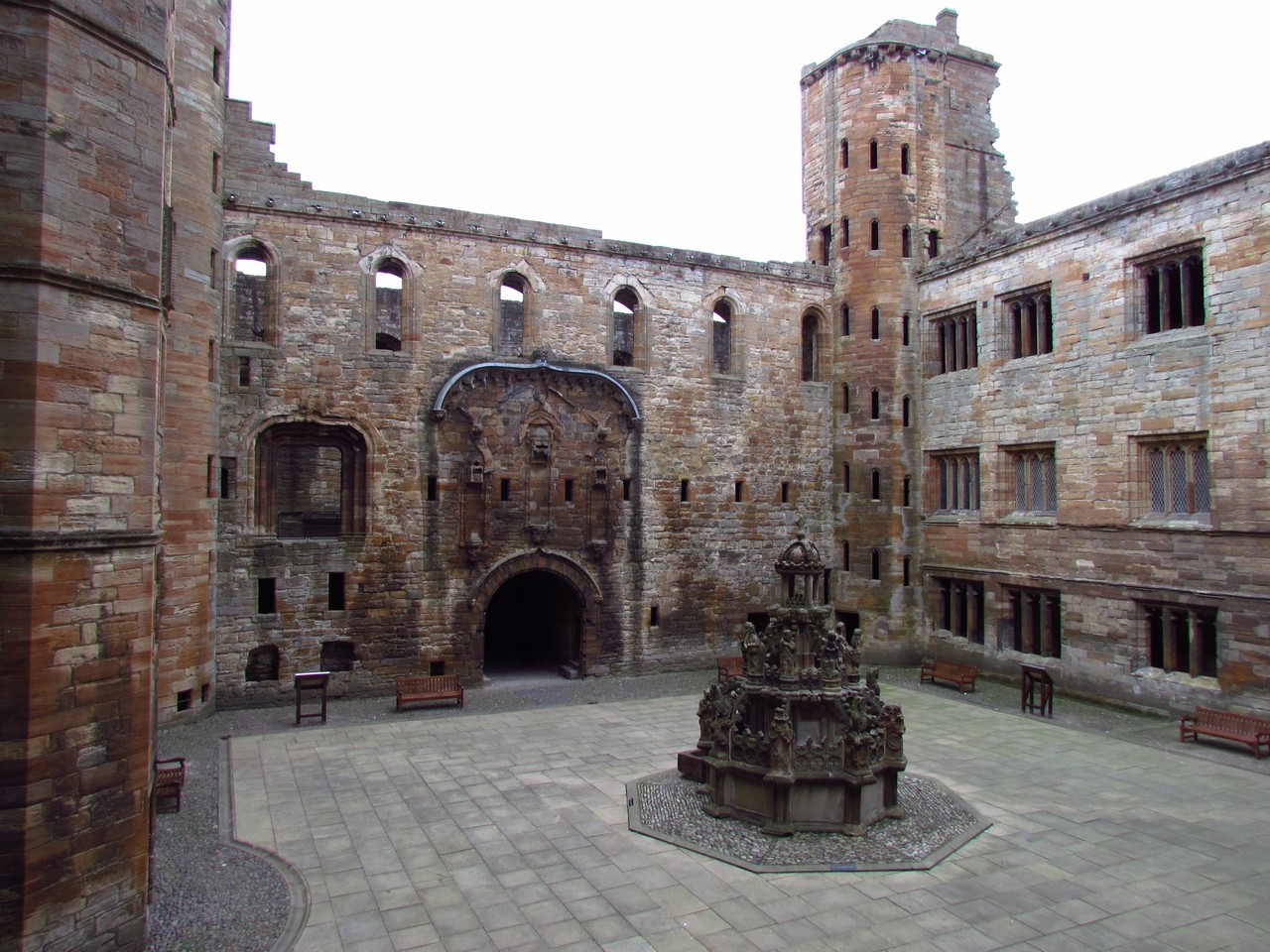
Today we drove to see Linlithgow Palace set in a park beside a loch. Most of the Stewart kings lived at the Palace. Numerous renovations to the palace’s grand facades and chambers were carried out as each sought to create the ideal modern palace. The location majestically situated in the center of Linlithgow, beside 15th-century St Michael’s Kirk, and overlooking the peel (park) and loch. The magnificent great hall despite being roofless, it still has the power to impress. The oriels are elegant projecting windows off the king’s and queen’s bedchambers. The fountain a beautiful three-tiered ‘wedding-cake’ structure in the center of the courtyard is magnificent. Along with the sculptures all around the palace of sumptuous stone-carved figures, including beguiling angel musicians in the royal chapel all make it a very worthwhile visit.


We then drove to South Queensferry to board the Maid of the Forth departing Hawes Pier to see Inchcolm Abbey. From the ferry we had unrivalled views of the magnificent Forth Rail Bridge and Forth Road Bridge. Inchcolm Island is by far the most beautiful of all of the island in the Firth of Forth. Called the 'Iona of the East' due to its similarity to the Island of Iona on the west coast of Scotland. Inchcolm Abbey dates back to the 12th Century, being founded by King David I, after his brother King Alexander I was forced to seek shelter there during a very stormy crossing of the Forth in 1123. The Abbey remains as the best preserved group of monastic buildings in Scotland. The medieval stone screens inside the belltower are rare survivals of medieval church fixtures. The cloister is remarkably complete and perfectly conveying the atmosphere of monastic life as well as the octagonal chapterhouse are exceptionally well preserved. At one time the monks used to abandon the island during the summer months for fear of English attack. Later in the 15th century, Abbot Walter Bower fortified the monastery and the brethren stayed on the island throughout the year. It was Abbot Bower who wrote Scotichronicon, one of the first histories of Scotland. During the First and Second World Wars the island itself was heavily fortified for fear that the Germans might attack the naval bases in the Forth.


 |
| Linlithgow Palace |
 |
| Fountain built by James V in 1537 |
 |
| North Range |
 |
| South Range |
 |
| Royal Apartments |
 |
| East Range |
 |
| Antechamber to the Chapel |
 |
| Chapel |
 |
| View over the Peel to the Loch |

 |
| Great Hall |
 |
| Court Kitchen |
 |
| West Range |


 |
| St Michael's Parish Church |


We then drove to South Queensferry to board the Maid of the Forth departing Hawes Pier to see Inchcolm Abbey. From the ferry we had unrivalled views of the magnificent Forth Rail Bridge and Forth Road Bridge. Inchcolm Island is by far the most beautiful of all of the island in the Firth of Forth. Called the 'Iona of the East' due to its similarity to the Island of Iona on the west coast of Scotland. Inchcolm Abbey dates back to the 12th Century, being founded by King David I, after his brother King Alexander I was forced to seek shelter there during a very stormy crossing of the Forth in 1123. The Abbey remains as the best preserved group of monastic buildings in Scotland. The medieval stone screens inside the belltower are rare survivals of medieval church fixtures. The cloister is remarkably complete and perfectly conveying the atmosphere of monastic life as well as the octagonal chapterhouse are exceptionally well preserved. At one time the monks used to abandon the island during the summer months for fear of English attack. Later in the 15th century, Abbot Walter Bower fortified the monastery and the brethren stayed on the island throughout the year. It was Abbot Bower who wrote Scotichronicon, one of the first histories of Scotland. During the First and Second World Wars the island itself was heavily fortified for fear that the Germans might attack the naval bases in the Forth.
 |
| Forth Road Bridge and Forth Rail Bridge (Red) |
 |
| Forth Rail Bridge |
 |
| Forth Road Bridge |


 |
| Inchcolm Abbey |

 |
| It was nesting time for the Seagulls who are much larger than Australian Seagulls |
 |
| In the 1400's this was the church which was then turned into domestic rooms at a later date |

 |
| Chapter House used for daily meetings |
 |
| It was such a lovely day the water was like a pond |


 |
| Grey Seals resting in the sun |

 |
| The Forth Rail Bridge was engineered to be twice as strong as needed as prior to building another bridge collapsed and 200 or so people perished in the water. |
 |
| Our home for the night Comelybank Guesthouse our home for the night |


