Like the author states at the conclusion of the article she was not intending on doing the amount of work on the Tor or Glastonbury as she has but something was calling her to do so, this is how I also feel. I was going to do only the one posting but I have been called to do more also so I hope you will indulge my many posts as I seek to obtain more knowledge of the area.
The soft green hill of the Tor, crowned with its enigmatic tower, has become a symbol of Glastonbury. It dominates the town and the surrounding landscape, and is the first sign to the traveller that Glastonbury is drawing near.
Centuries of legends and folklore have gathered around this Tor. In their various ways, these tales all demonstrate one thing – that the Tor is a place where the veil between the worlds is thin. Strange experiences here are usually interpreted according to the beliefs of the times. An otherworldly being met on the Tor might be called a fairy in one century, a nature spirit in another and ET in more recent years.
Like Glastonbury, the Tor has come to host a large variety of mystical beliefs. Nature mythology, paganism, Christian legends, and newer ideas about life the universe and everything have all found a comfortable, nurturing niche for themselves within Tor lore. It’s as if the genius loci of the Tor is an especially powerful spirit of place: able to attract and foster all kinds of ideas, but bigger than all of them – like a giant ancient tree with its ever-changing population of little birds and squirrels.
It’s certainly ancient. Modern archaeology agrees with the folklore about that. Many thousands of years ago, the Tor may have been one of seven islands that were left unsubmerged by a great flood. This would make it an important focus of regeneration and life, both symbolically and practically. It may even have been designed as such by those who foresaw the flood, and who deliberately infused the Tor with extra power and intent, thus making it our direct link to an ancient lost world.
Legends say that the top once sported a stone circle like Stonehenge. In the 1970s a West Country seer, who prefers not to be named, described her vision of how it might have been: "The Tor is not the same now as it was then. It has had a portion taken off the top, and there was a temple built on the top, like a Greek temple, but circular. Within it was the most beautiful mosaic type of floor, and it was set out like a zodiac. There were twelve columns around it, whitish in colour. Under the flooring there was a hidden vault. The top was domed. There were seven guardians there in pale blue robes. The white temple was on top of the Tor with trees and rushes and water all the way round. There was a very fragrant scent there. Just being on that islet was restorative in itself."
Since writing this, an exciting development has taken place. Archaeologists Nancy and Charlie Hollinrake of the Glastonbury Antiquarian Society announced that they have unearthed on top of the Tor the foundations of what looks very much like an ancient circular temple!
The Tor was an islet for centuries, as the flood waters took a long time to recede. 'Somerset' is short for 'summer settlement' because the area was too flooded to inhabit in winter. The Tor was called 'Ynys Witrin' or 'Isle of Glass' (or Isle of Seeing), connected to the mainland by only a narrow strip of land at low tide. The people who recognise it enhance the power of any sacred place. This long period of semi-isolation may have not only preserved the otherworldly nature of the Tor, but also added to its aura of specialness through the eyes of the people.
In archetypal symbolism, hills and high places are like bridges between earth and sky. They represent a link between material reality and the unseen dimensions. The early Celts thought of high places as gods – powerful beings in a world where all nature was inhabited by conscious entities. Roman influence later modified that idea, saying it’s not the hills that are alive, but the gods who live in them. The combination of these beliefs with the special qualities of the Tor made it almost inevitable that Glastonbury Tor would come to be seen as the home of many strange beings.
Fairy Stories
Stories about these fairy people became merged with Celtic personifications of the forces of nature. Gwyn ap Nudd, who later became the Tor King of the Fairies, began his career as a symbol of death. He was Lord of the Underworld, like the Norse Odin. His feared Wild Hunt was a harbinger of death, and bringer of bad luck to all who saw it. It would hurtle across the night sky, the white Yeth hounds running before, hunting souls to take back to the underworld.
As the arts of cultivation began to tame the power of nature, the Wild Hunt lost its raw terror. The faintest echo of it still rides our winter nights in the form of Santa’s merry sleigh. Somewhere along the way, Gwyn ap Nudd changed from Lord of the Underworld to King of the Fairies. His court established itself in the magically hollow Glastonbury Tor. But memories of the Wild Hunt lingered, and people remained wary of fairies. They were described as tall dark beings, just itching to play mocking tricks on mortals, kidnap or even kill them if they had half a chance. Gwyn was seen as a kind of mediator between them and the human race. He was said to be sometimes the only thing that stood between people and their complete destruction by these scary fairies. Even so, he was apparently barely able to restrain his crew, and couldn't resist a bit of malice himself at times.
As the agricultural life settled people into working with the seasons, the forces of nature began to feel cosier. It was then said that every year Gwyn ap Nudd stole the spring maiden Creiddyladd from Gwythr ap Greidawl. The rivals were then fated to fight an annual, unwinnable battle over her on the Tor every May Day till Doomsday, in a dramatisation of the yearly cycle of the seasons.
There are still other observations about fairies that might have come from experiences of actual encounters with some form of non-human entity. The church did all it could to suppress these stories. Anyone talking openly about this kind of experience stood in danger of a witchcraft trial. Despite that, a large number of these tales survive.
A huge number of fairy encounters are associated with magical hills. Fairy hills were thought of as hollow, in the sense that there was another realm within them, making the hill seem bigger inside than out. This inner realm was called Annwn or Avalon. A persistent ancient belief says there’s an entrance to Annwn somewhere on the Tor, which was well known as a strange, magical place.
Apart from being an outstanding leader, Arthur also stood for a newish kind of spirituality that had taken hold in Britain. This was a strong mix of Celtic mysticism and Christian morality, with a good dash of Roman codes of honour. The barbarian invaders did not share those beliefs or attitudes. They were therefore a threat to the new faith, and the way of life that went with it. Thus Arthur was a defender of much more than the land and the people – he was also the champion of these values, and fighting a kind of holy war.
The new beliefs were still firmly rooted in the Celtic underworld of Annwn, which was closely associated with Glastonbury Tor. A story about the young Arthur says he visited that realm, and while there was presented with the cauldron of rebirth and the sword of power. Although he was defeated in battle in the end, the enduring power of what Arthur represents suggests that these gifts were real in a way that has long since gone beyond sixth century military matters.
Legend speaks more gently of another Christian secret protected by the Tor – Joseph of Arimethaea’s concealment of the Holy Chalice. The chosen spot is thought to be near to the Chalice Well natural spring at the foot of the Tor. The spring is associated with blood, because of the red colour of the water and its strong iron content. This has been interpreted in different ways. Christianity says that it represents the water and blood of Christ’s crucifixion, and was turned that way by the nearby burial of the sacred chalice. There are undertones in that story of older blood sacrifices to propitiate the gods. Many people today prefer to think the Chalice Well water represents the life-giving blood of the earth mother.
Fashions in belief are changing again, and once again the Tor is somehow the perfect model for the latest style, while never a fashion victim. Dion Fortune, the twentieth century writer and mystic, said: "For the Tor keeps its spiritual freedom. It has never cried ‘Thou hast conquered, O Galilean!’"
Jenny describes below UFO sightings that she and three friends had on the Tor at the time of a special astrological alignment. In recent years people have become much more aware of astrology beyond the daily forecast level, and a new chapter of astrology related Tor lore is opening.
In distant times before the knights and fairies, the standing stones on top of the Tor may have been used as a lunar observatory to predict eclipses. It’s also believed that more than four thousand years ago the Phoenicians created the Glastonbury Zodiac – the giant signs of the Zodiac that are in the landscape around Glastonbury. The Elizabethan magus, Dr. John Dee, was the first to discover this map. That knowledge was ignored and forgotten until 1929 when the artist Katherine Maltwood discovered it again. In the map, the Tor is in the sign of Aquarius. This is depicted as a rising Phoenix with wings outstretched, representing rebirth in the sense of radical transformation. The bird’s neck is the Tor tower, and its head drinks from the blood spring of Chalice Well, representing the Holy Grail.
Then all of a sudden the feeling left us and the clouds – very quickly – all came back into place. We just stood there, silent. We were so – so – nonplussed. It was just so incredible. We said, you know, this was another reality – because the sky had been too blue for this time of night. Somehow we'd slipped into another reality."
Brenda agreed to be regressed to see if we could find out anything else about that experience in her unconscious memories.
These are some of the notes Brenda made:
You can't go into the higher vibrational reality while in the denser form of 3D. You can travel into it with the energy of your thought. Thought travels in a finer energy form.
Level 1: Third dimension. The physical is surrounded by the auric field, and that is surrounded by the void – which we call space – which is inert energy – it exists. Energy is always present, there is no such thing as space, only energy in a lighter form. We take this energy and use thought to create things – give it form.
Level 2: Where we see the space craft in the sky – the energy field of the form.
Level 3: Finer energy – hardly perceptible from the space it is in. The form is hardly noticeable from its surroundings, the energy is so refined. To perceive this, our thought is at the same refined level.
The soft green hill of the Tor, crowned with its enigmatic tower, has become a symbol of Glastonbury. It dominates the town and the surrounding landscape, and is the first sign to the traveller that Glastonbury is drawing near.
 |
| Photo Source http://www.isleofavalon.co.uk |
Like Glastonbury, the Tor has come to host a large variety of mystical beliefs. Nature mythology, paganism, Christian legends, and newer ideas about life the universe and everything have all found a comfortable, nurturing niche for themselves within Tor lore. It’s as if the genius loci of the Tor is an especially powerful spirit of place: able to attract and foster all kinds of ideas, but bigger than all of them – like a giant ancient tree with its ever-changing population of little birds and squirrels.
It’s certainly ancient. Modern archaeology agrees with the folklore about that. Many thousands of years ago, the Tor may have been one of seven islands that were left unsubmerged by a great flood. This would make it an important focus of regeneration and life, both symbolically and practically. It may even have been designed as such by those who foresaw the flood, and who deliberately infused the Tor with extra power and intent, thus making it our direct link to an ancient lost world.
 |
| Photo Source http://www.isleofavalon.co.uk |
Since writing this, an exciting development has taken place. Archaeologists Nancy and Charlie Hollinrake of the Glastonbury Antiquarian Society announced that they have unearthed on top of the Tor the foundations of what looks very much like an ancient circular temple!
The Tor was an islet for centuries, as the flood waters took a long time to recede. 'Somerset' is short for 'summer settlement' because the area was too flooded to inhabit in winter. The Tor was called 'Ynys Witrin' or 'Isle of Glass' (or Isle of Seeing), connected to the mainland by only a narrow strip of land at low tide. The people who recognise it enhance the power of any sacred place. This long period of semi-isolation may have not only preserved the otherworldly nature of the Tor, but also added to its aura of specialness through the eyes of the people.
In archetypal symbolism, hills and high places are like bridges between earth and sky. They represent a link between material reality and the unseen dimensions. The early Celts thought of high places as gods – powerful beings in a world where all nature was inhabited by conscious entities. Roman influence later modified that idea, saying it’s not the hills that are alive, but the gods who live in them. The combination of these beliefs with the special qualities of the Tor made it almost inevitable that Glastonbury Tor would come to be seen as the home of many strange beings.
 |
| Photo Source http://www.isleofavalon.co.uk |
The earliest group known to move into the Tor was the fairies. In those days, fairies were nothing like our wee pictures of them. They were described as tall, youthful despite great age, and 'fair' – ie. beautiful. At that time they were associated with certain constellations – the Pleiades, Ursa Major, and Sirius. They were said to have brought knowledge to the local people, especially about astrology and healing. Different peoples from all over the world have strikingly similar mythologies.
Stories about these fairy people became merged with Celtic personifications of the forces of nature. Gwyn ap Nudd, who later became the Tor King of the Fairies, began his career as a symbol of death. He was Lord of the Underworld, like the Norse Odin. His feared Wild Hunt was a harbinger of death, and bringer of bad luck to all who saw it. It would hurtle across the night sky, the white Yeth hounds running before, hunting souls to take back to the underworld.
 |
| Photo Source http://www.isleofavalon.co.uk Gwyn ap Nudd |
As the agricultural life settled people into working with the seasons, the forces of nature began to feel cosier. It was then said that every year Gwyn ap Nudd stole the spring maiden Creiddyladd from Gwythr ap Greidawl. The rivals were then fated to fight an annual, unwinnable battle over her on the Tor every May Day till Doomsday, in a dramatisation of the yearly cycle of the seasons.
 |
| Photo Source http://www.isleofavalon.co.ukCreiddylad and Gwythyr |
As the Middle Ages farmed on, people learned that potential threats from both fairies and nature could be avoided by heeding certain rules. By then fairies were seen as mostly helpful, but still with a few nasty surprises up their floaty green sleeves. That side of their nature was placated with offerings. It became the custom to leave little servings of food and drink out for them, which the fairies seemed to like.
There are still other observations about fairies that might have come from experiences of actual encounters with some form of non-human entity. The church did all it could to suppress these stories. Anyone talking openly about this kind of experience stood in danger of a witchcraft trial. Despite that, a large number of these tales survive.
A huge number of fairy encounters are associated with magical hills. Fairy hills were thought of as hollow, in the sense that there was another realm within them, making the hill seem bigger inside than out. This inner realm was called Annwn or Avalon. A persistent ancient belief says there’s an entrance to Annwn somewhere on the Tor, which was well known as a strange, magical place.
Not many sought that entrance, because of certain dangers everyone knew about in those days. One problem was the difference between fairy time and ours. A heedless Annwn adventurer might slip permanently into the past or future. Anyone who returned from a fairy foray was likely to discover large chunks of missing time in their lives. More than one medieval experiencer reports having spent only half an hour or so with the fairies – but when they returned, found that many years had passed in their world. Everyone they knew had grown old or died.
Another danger was the food. The rule was, if you visit Annwn, don’t eat or drink anything. The fairies were friendly and hospitable, usually offering visitors food and drink. But any human who accepts fairy fare will never be able to leave their world again. The food and drink might stand for magical powers or advanced knowledge available in the other realms. Once these are assimilated – understood – it would be impossible to return to the old ways again.
Another danger was the food. The rule was, if you visit Annwn, don’t eat or drink anything. The fairies were friendly and hospitable, usually offering visitors food and drink. But any human who accepts fairy fare will never be able to leave their world again. The food and drink might stand for magical powers or advanced knowledge available in the other realms. Once these are assimilated – understood – it would be impossible to return to the old ways again.
 |
| Photo Source http://www.isleofavalon.co.ukSaint Collen |
A famous Tor story is the encounter between St. Collen with Gwyn ap Nudd. St. Collen, a devout Christian monk, had heard about the heathen fairies of the Tor, and decided to do something about it. He found the special place on the Tor that locals said was the entrance to Annwn, settled himself down, and put out for an encounter. Before long, Gwyn the mediator answered him in person. He led St. Collen into his court, where the fairies offered their food and drink. The monk refused these offerings, and threw holy water at his hosts. At that, he was instantly back on the grassy slopes of the Tor surface. He wound his way home, satisfied that his actions had banished fairies from the surface of the Tor. Whether this encounter was a literal event or not, it dramatically illustrates how the church was driving the other realms more and more underground.
Although cautious about the fairy world, people did like their fairs. These were festive occasions to gather, exchange news, and trade horses or magical wares. The Tor was naturally one of the major venues. By 1127 the annual Tor Fair was so successful and popular that King Henry I granted a charter for them to continue as long as they were held on the Tor at least two days a year. It was at one of these Tor fairs that the famous Blondin did a tightrope act so good we still have the reports praising it. Today’s psychic fairs are continuing a tradition begun hundreds of years ago, and which, according to history, was originally inspired by the fairies.
Although cautious about the fairy world, people did like their fairs. These were festive occasions to gather, exchange news, and trade horses or magical wares. The Tor was naturally one of the major venues. By 1127 the annual Tor Fair was so successful and popular that King Henry I granted a charter for them to continue as long as they were held on the Tor at least two days a year. It was at one of these Tor fairs that the famous Blondin did a tightrope act so good we still have the reports praising it. Today’s psychic fairs are continuing a tradition begun hundreds of years ago, and which, according to history, was originally inspired by the fairies.
King Arthur and the Tor
The original Arthur was a valiant defender of the Celtic/Christian West Country against Angle and Saxon invasion after the Romans had left in the 6th century. Tintagel and Cadbury Castle were probably his main strongholds – but so was Glastonbury Tor, according to both legends and evidence. The Tor had enough strategic and symbolic importance for this to be more than likely.
 |
| Photo Source http://www.isleofavalon.co.ukArthur |
Apart from being an outstanding leader, Arthur also stood for a newish kind of spirituality that had taken hold in Britain. This was a strong mix of Celtic mysticism and Christian morality, with a good dash of Roman codes of honour. The barbarian invaders did not share those beliefs or attitudes. They were therefore a threat to the new faith, and the way of life that went with it. Thus Arthur was a defender of much more than the land and the people – he was also the champion of these values, and fighting a kind of holy war.
The new beliefs were still firmly rooted in the Celtic underworld of Annwn, which was closely associated with Glastonbury Tor. A story about the young Arthur says he visited that realm, and while there was presented with the cauldron of rebirth and the sword of power. Although he was defeated in battle in the end, the enduring power of what Arthur represents suggests that these gifts were real in a way that has long since gone beyond sixth century military matters.
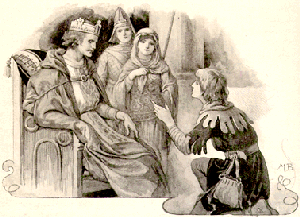
Other associations with the Tor weave in and out of Arthurian legend. There are echoes of Gwyn’s kidnapping of Creiddyladd in the story about Guinevere’s abduction. A local chieftain, Melwas, had a stronghold on the Tor. He kidnapped Arthur’s wife Guinevere, and held her prisoner there. The marshes and swamps surrounding the Tor made it difficult for Arthur to attack with any hope of success. Recent archaeology has found that there was a fifth century fort on the Tor, accessible by only one narrow and well-fortified strip of land. So Arthur asked for help from the Christian Abbot, Gildas. St. Gildas obliged, and was a diplomatic hit. Without a battle, Melwas returned Guinevere to Arthur.
 |
| Photo Source http://www.isleofavalon.co.ukGuinevere |
But the advantages of the Tor were clearly not lost on Arthur. Perhaps with some of Guinevere’s new-found inside knowledge, he returned later, better prepared. This time he successfully conquered Melwas and made the Tor his own. This was also to protect the entrance to Annwn, although that may have been how people saw it in retrospect.
With such a turbulent history, it’s not surprising that the Tor is said to be haunted. One of its regulars is a ghost surrounded with golden light, reputed to be Guinevere. A local woman describes her encounter with another Tor ghost: "About ten years ago I was walking down the Tor on my own when I noticed a man in a long black cloak walking down about ten yards to my right. I didn’t take much notice. This was before there were paths and steps up the Tor. He passed behind a stand of trees and should have come out still parallel with me but he didn’t reappear. I stood and watched because he seemed to have disappeared! I looked behind the trees but he wasn’t there and there was nowhere else he could have gone to. I was very shaken and though I find it difficult to believe in ghosts in full daylight, I have no explanation for his disappearance."
Another spooky story says that after Arthur’s final departure to the mystic realms, the ghost of a knight with glowing red eyes and black armour began to haunt the Abbey. His mission was to suppress or destroy all records of Arthur. There could be some truth in this, although the knight may not have been a ghost. After winning the Battle of Camlan c.535-537CE, the invaders probably felt insecure with the continuing West Country loyalty towards Arthur, and decided to eradicate all memory of him.
Although most records of Arthur’s career may have been deleted, the troubadours, 500-600 years later, more than made up for it. Living by the news and entertainment they brought, doing the rounds of the courts and castles, they spread the story of Arthur throughout Britain and Europe. Ever since then, Arthurian stories have been celebrated, romanticised and refined, with fresh interpretations still flowering from that rich soil. Fifteen hundred years on, the spirit of Arthur is alive and well in the legends that have become a vital part of the British psyche.
Anyone who wants to see Arthur’s ghost in person could try Hunting Causeway between Cadbury Castle and Glastonbury next Christmas Eve. This runs along a ley line linking Cadbury, Glastonbury, and another centre in South East Wales. According to folklore, every Christmas Eve the once and future king leads a ghostly procession of knights along that route from Cadbury to Glastonbury. Sometimes only the silver glint of horseshoes can be seen, but many say they have heard the sounds of this procession passing by. It seems apt that the spirit of Arthur is seen as moving in this stately and ceremonial way towards his old mystical stronghold, the Glastonbury Tor.
Anyone who wants to see Arthur’s ghost in person could try Hunting Causeway between Cadbury Castle and Glastonbury next Christmas Eve. This runs along a ley line linking Cadbury, Glastonbury, and another centre in South East Wales. According to folklore, every Christmas Eve the once and future king leads a ghostly procession of knights along that route from Cadbury to Glastonbury. Sometimes only the silver glint of horseshoes can be seen, but many say they have heard the sounds of this procession passing by. It seems apt that the spirit of Arthur is seen as moving in this stately and ceremonial way towards his old mystical stronghold, the Glastonbury Tor.
 |
| Photo Source http://www.isleofavalon.co.uk |
Christian Tor Lore
The stones from Arthur’s fort on the Tor were later used to build the 12th century Church of St.Michael there. Hilltop churches were often dedicated to St.Michael, who was the Christian version of older gods connected with high places and power meridians of the earth – sometimes also called dragon lines.
On Sept 11th 1275, an earthquake shook down the Tor’s new church. Some said this was the fairies’ doing. The church was built again – but again, it didn’t last. All that’s now left of it is the tower that was added in the 1360s. By whatever means, the Tor has successfully turned its church into the pagan symbol of an upstanding tower.
The stones from the rubble of this church, originally part of Arthur’s fort, then went to build the Abbey. With the dissolution of the monasteries in 1539, the Abbey was reduced to a stone quarry. People then used those stones for local building works. If stones could speak, some of the older houses, pubs and hostelries around Glastonbury would have some interesting tales to tell.
After the dissolution, there was a grim episode when Richard Whiting, the Abbey’s last abbot, was dragged up the Tor on hurdles and hanged there, along with two of his priors. The wealth of the Abbey was supposedly sent to swell Henry VIIIth’s coffers in London. But there’s a good chance he didn’t get it all. There are stories about secret tunnels radiating in many directions from the Abbey, one of which links directly with the Tor. The limestone in the White Spring is geological evidence of tunnels under the Tor. Some of the Abbey’s assets may have found their way into these tunnels, and may even still be there. Legends say that when the secret treasure is found again, it will herald a new age of peace and happiness. This treasure may not be the old booty from the Abbey though.
There are stories about monks who found these tunnels, but were 'insane' or 'unable to speak' when they returned. Maybe something in the experience unhinged their sheltered monastic minds. Maybe their accounts sounded so weird they were dismissed as mad. Or maybe destroying their credibility by calling them mad was a wily ploy to keep certain things quiet. The tunnels under the Abbey and the Tor may still hold forbidden secrets no one knows to this day – or speaks about.
 |
| Photo Source http://www.isleofavalon.co.uk |
From Starr, a practising Druid who has contacted us:
"The historical story, from a very old source, 17th century, says of a large tunnel leading into the Tor which had a large cave in it, with two pools of natural spring water that flowed underground to the Chalice Well. It is said the cave was part of a druidic initiation, a journey into the dark and the inner self. There were also steps leading down from the top into the cave, which was rediscovered, then promptly covered up (for reasons unknown).
"As for the cave under the Tor, it was bricked up by the local water board and [only re-opened recently – now the 'White Spring'.] A local who was very interested in the history of the site relayed to me that in the 60's his dad was part of a project to hollow out the Tor further and place a water tower inside, to harness the natural spring, thereby hiding a potential eyesore, though ruining the cave and profiting at the same time. This same person showed me one of the mentioned tunnels which still lead into the Abbey from outside of town. The bit I walked was, or at least seemed to be, several hundred yards."
 |
| Photo Source http://www.isleofavalon.co.uk |
Joseph of Arimathaea
Legend speaks more gently of another Christian secret protected by the Tor – Joseph of Arimethaea’s concealment of the Holy Chalice. The chosen spot is thought to be near to the Chalice Well natural spring at the foot of the Tor. The spring is associated with blood, because of the red colour of the water and its strong iron content. This has been interpreted in different ways. Christianity says that it represents the water and blood of Christ’s crucifixion, and was turned that way by the nearby burial of the sacred chalice. There are undertones in that story of older blood sacrifices to propitiate the gods. Many people today prefer to think the Chalice Well water represents the life-giving blood of the earth mother.
Fashions in belief are changing again, and once again the Tor is somehow the perfect model for the latest style, while never a fashion victim. Dion Fortune, the twentieth century writer and mystic, said: "For the Tor keeps its spiritual freedom. It has never cried ‘Thou hast conquered, O Galilean!’"
 |
| Photo Source http://www.isleofavalon.co.uk |
Lines of Power
Dowsing methods have now traced many power lines in the earth that for centuries were known to folklore. These are geomagnetic lines in the earth, like acupuncture meridians in the body. Ancient people found that using them made all forms of travel, messages and communications easier. Christian churches later replaced the older sacred sites that were built along these lines. The Michael line is called that because most of the churches on it are dedicated to St.Michael, who was the Christian version of the protective male deity originally associated with this line. In the same way, St.Mary churches delineate the Mary line and replaced older shrines to a nurturing and gentle earth mother. The male and female nature of the two lines was thus preserved and continued by the Christian interpretation.
The Michael and Mary lines are especially powerful. They connect major sacred sites throughout the South West and beyond. But it’s only on the Tor that their energies combine. In a harmonious dance of earth patterns, the lines move ever closer as they approach the summit. At the top, they merge and unite. Perhaps this is what makes it easy for so many other kinds of opposites to harmoniously come together on the Tor.
When they flow down from the Tor again, the lines then pass through the other major Glastonbury sites – Chalice Well, the Abbey and Wearyall Hill. Their energy may be an important source of the strong mystical element that’s been associated with these places for many hundreds of years.
Apart from their connection with sacred sites, these lines are also associated with strange lights, and other unexplained phenomena. Over the years, a substantial number of credible witnesses have seen balls of light around the Tor. These are described as luminous, alive, and somehow conscious. People say it feels as if the lights present themselves on purpose in some way. They can be round, oval, small as ping-pong balls or big as beach balls; misty, sparkly, luminous or glowing; sometimes alone, sometimes in groups; hovering, floating or travelling purposefully through the air, appearing and disappearing at will. Not only white, but reds, greens, mauves and other colours have been reported. During the great solar eclipse of August 1999, two separate and unconnected groups of people reported seeing a large orange ball of light hovering to the south of the Tor. Adventurous people who sleep in the tower talk about strange and vivid dreams, and a white light that sometimes fills the place. Whatever these lights are, they seem connected in some way with the powerful energies of sacred sites and earth meridians.
 |
| Photo Source http://www.isleofavalon.co.uk |
The Terraced Maze
A physical indication of what might have been some ancient ritual, is the terraced pathway that spirals around the Tor. Although very worn now, it can still be traced. Scientific surveys currently think that it was made about four or five thousand years ago – at about the same time as Stonehenge.
Starting at the bottom, it winds around and up the Tor in a backtracking maze. The pattern it makes is almost identical to the labyrinth found on ancient Cretan coins, and also the Native American Hopi people’s representation of Mother Earth.
An examination of this path has found that it seems to end before getting to the top. The place where it suddenly disappears is marked with a large, smooth, oval-shaped stone – locally known as the eggstone. There are very few big stones on the Tor, and from their positioning they look like deliberately placed markers. When the solemn St. Collen decided to have it out with the King of the Fairies, he chose the best spot he’d heard about for this kind of contact. He described it as "a little place under a rock in a secret, out-of-the-way place". This sounds like the eggstone, which is quite difficult to find, in an obscure spot and hidden by bushes and brambles.
Like much else about the Tor, the terraced pathway still seems active. Some have seen it glowing with a strange light. Dion Fortune says: "Many times the Tower is reported to have been seen rimmed in light; a warm glow, as of a furnace, beats up from the ground on wild winter nights, and the sound of chanting is heard from the depths of the hill. Towering forms of shadow and light are seen moving on the lower slopes."
 |
| Photo Source http://www.isleofavalon.co.uk |
Some Accounts of Paranormal Experiences
A Glastonbury woman, Sue, [unless otherwise stated, all given names are pseudonyms] said that one late afternoon she did some of the spiral walk, and headed back to town once dusk began to fall. Near St. John’s Church in the High Street she suddenly saw a bright red sparkling light appear out of nowhere in the sky. It was quite low, and about the size of a beach ball. It travelled a short way across the sky and then suddenly disappeared again. It had been totally silent the whole time. She said it felt as if it had been deliberately presenting itself to her. "Then it just seemed to dissolve into itself".
A Glastonbury woman, Sue, [unless otherwise stated, all given names are pseudonyms] said that one late afternoon she did some of the spiral walk, and headed back to town once dusk began to fall. Near St. John’s Church in the High Street she suddenly saw a bright red sparkling light appear out of nowhere in the sky. It was quite low, and about the size of a beach ball. It travelled a short way across the sky and then suddenly disappeared again. It had been totally silent the whole time. She said it felt as if it had been deliberately presenting itself to her. "Then it just seemed to dissolve into itself".
An even stranger experience befell another Glastonian, Lydia. She tells the tale in her own words:
"I used to go for evening walks quite a lot. One night I went for a walk and I went up Bushey Combe and then by the side of the Tor, along the back way. At that time there were lots of travellers’ vans around there, so I was aware of their presence, and the various little noises coming from them.
And it’s your typical 'walking through the mists' story I'm afraid. As I walked up Well House Lane I suddenly came to this wall of mist. So I thought, ooh it’s the mists of Avalon, jolly good, I'm going to go through the mists of Avalon.
And I walked into this fog bank. It wasn't very thick. There was only like a band of it for a while. And when I came out the other side, there were no vehicles. No vehicles. There wasn't a single car – not a traveller van. There was nothing. At all. Apart from the Tor. I thought, that’s odd. In all the time I've been going up there, I’d never, never gone up there when there was nobody else around. Apart from this one occasion.
 |
| Photo Source http://www.isleofavalon.co.uk |
I thought I’d go up the Tor. As I was walking up there, you know you get that vague prickling? I was thinking, there’s something not right here. I couldn't quite put my finger on it. There was no sound. No sound at all. And it was quite foggy around the bottom of the Tor – so the Tor was like an island and I couldn't see past the fog that was all around it.
So I got to the top of the Tor and there wasn't a soul up there. It’s the first time I've ever been up there alone. And I was looking up at the sky. The sky was quite clear above the fog. I was looking up at the stars and thinking, there’s something wrong. There’s something really wrong. And the only way I could describe it, it was like everything had suddenly taken a slight shift to one side. I'm still on the Tor. It’s still the same stars. But it’s all wrong. Like everything has tilted over just a little bit. I was shaking me head and rubbing me eyes and thinking, Oh – this is a bit weird – what’s going on here? Looking at the sky and thinking – there’s something I couldn't put my finger on, but there’s something not right.
So I got to the top of the Tor and there wasn't a soul up there. It’s the first time I've ever been up there alone. And I was looking up at the sky. The sky was quite clear above the fog. I was looking up at the stars and thinking, there’s something wrong. There’s something really wrong. And the only way I could describe it, it was like everything had suddenly taken a slight shift to one side. I'm still on the Tor. It’s still the same stars. But it’s all wrong. Like everything has tilted over just a little bit. I was shaking me head and rubbing me eyes and thinking, Oh – this is a bit weird – what’s going on here? Looking at the sky and thinking – there’s something I couldn't put my finger on, but there’s something not right.
I was up there for a while. Then I heard voices, and I heard somebody else coming up the Tor. I started to feel really disorientated. I felt, I've got to get back into town. I've got to get off here. I don’t want to be here.
 |
| Photo Source http://www.isleofavalon.co.uk |
So I started to walk down the Tor. I was walking down the long path. And you know the ridges round the Tor? They were glowing. It was like silver light. I was thinking, Ooh, I've heard about this maze and how it sometimes can glow, and I thought, oh this is great! I was walking down thinking, this is wonderful! But I kept stumbling on the path and I kept shaking my head, feeling I've got to clear my head here. I was really disorientated. I was getting near the bottom and I went through this bank of fog. Normally you see all the lights of the town, but there wasn't anything. And then I walked through this bank of fog and suddenly I could see the lights.
And when I saw the lights in Well House Lane I thought for an absolute split second – hang on! They shouldn't be here! This is all wrong; there shouldn't be any lights. Then – hang on – yes, there should be. There SHOULD be some lights! And once I got out onto Well House Lane I felt totally normal again.
But something very odd had happened. Really odd. I feel like I walked into something and it was a slight shift of reality. Very slight. I just felt really odd. That I wasn't standing where I was actually standing. And everything I was looking at wasn't in its right place. It was all slightly off, and that’s the only way I can explain it."
 |
| Photo Source http://www.isleofavalon.co.uk |
There is currently some debate over whether the elves and fairies people used to see were really ETs all along – or whether it’s the other way round. Given the Tor’s history as friendly host to a wide variety of other worldly phenomena, it’s hardly surprising that in recent years there have been UFO sightings from its slopes.
Jenny describes below UFO sightings that she and three friends had on the Tor at the time of a special astrological alignment. In recent years people have become much more aware of astrology beyond the daily forecast level, and a new chapter of astrology related Tor lore is opening.
In distant times before the knights and fairies, the standing stones on top of the Tor may have been used as a lunar observatory to predict eclipses. It’s also believed that more than four thousand years ago the Phoenicians created the Glastonbury Zodiac – the giant signs of the Zodiac that are in the landscape around Glastonbury. The Elizabethan magus, Dr. John Dee, was the first to discover this map. That knowledge was ignored and forgotten until 1929 when the artist Katherine Maltwood discovered it again. In the map, the Tor is in the sign of Aquarius. This is depicted as a rising Phoenix with wings outstretched, representing rebirth in the sense of radical transformation. The bird’s neck is the Tor tower, and its head drinks from the blood spring of Chalice Well, representing the Holy Grail.
Stories about the Knights of the Round Table may be referring to this huge circular map of the twelve constellations. Many correspondences can be found identifying the knights with the different zodiac signs. It seems likely that the Phoenix Aquarius of the Tor symbolises the transformed 'future king' aspect of Arthur. Arthur as a symbol of latent power that will one day return may be connected with knowledge and messages encoded in this map. Perhaps this is really the secret treasure of the Tor.
 |
| Photo Source http://www.isleofavalon.co.uk |
It seems appropriate that the Tor is becoming a favourite spot from which to view important stellar alignments, and is becoming associated with new knowledge about astrology. Jenny describes her Tor experience at the time of a major planetary configuration:
"I had an experience with a group of friends when we drove from Cornwall to the Tor in Glastonbury. About two years ago there was an astrological formation in the sky, which made a six-pointed star, do you remember? So we decided to see it from the Tor. There were four of us in the car. We were driving along the motorway and suddenly saw this thing zig-zagging across the sky. It was like a white light, and going really fast.
One of us said, 'Oh! What's that?'. And everybody else turned to see it. It was going really fast. It was like a triangular shape with three lights – one at the top of the triangle and two at the bottom. It came to the top of the car and hovered above us for a while. It was really, really low and it just hovered there for a bit. Then it lifted and went. Our driver was really skeptical and he was saying, "No, it's a plane." And we were saying, "No, look, it can't be a plane". We were really sure about it. It was right there.
Then we were on the Tor that night. There were about ten other people there. And we saw another UFO! It was a white light, zig-zagging really fast. We saw it from the Tor and so did all those other people who were there. We took pictures as well but they came out as just lights."
 |
| Photo Source http://www.isleofavalon.co.uk |
While that was relatively straightforward, the next account goes much further. This experience took Brenda from spaceship sightings into much deeper waters. But at no stage was she ever frightened. On the contrary, she felt excited and uplifted by it, and considers the experience to be a wonderful gift.
Nuts and bolts warning: those who believe that 'real' means 'physical' may find this story hard to accept.
Brenda: "This was when I was on holiday in Glastonbury, at a sort of healing centre. One of the chaps that was there – Mike – he and I really felt a kinship with each other. We'd take the dogs for walks in the evening. But the night this happened, he said, 'Let's just go for a walk, don't let's take the dogs. I feel that something special's going to happen, and it's my last night.'
So we donned our raincoats and took an umbrella because it had been a wet day. It was still very cloudy and dark. We kept to the road – the Tor was too muddy to walk up. We got to a gate that looks over a field, and we just stood there, looking over this gate at the Tor. Our eyes got used to the light and the Tor looked like a great big magic majestic thing standing there.
And while standing there, my head felt funny. I went all kind of wobbly. I thought, Ooh, what's going on? I was feeling quite dizzy.
It was a really dark night and the clouds were heavy with rain. We were looking up at the sky. I don't know how long we stood there looking up at the sky. All of a sudden there was a clear patch in the clouds. And I saw it! It was like a circle – there were about five lights in a circle.
I said, 'Mike, look up, look there, look! There it is! Can you see it?'.
 |
| Photo Source http://www.isleofavalon.co.uk |
And he caught sight of it as well. We danced up and down like two kids, watching these lights move across the sky. Then they went into the clouds and vanished. I said, 'Gee, we've seen them, we've seen them!'
And we still kept on looking. Then I saw a star. It moved diagonally across the sky. For quite some distance I watched this moving star. It was just one bright light. And that moved across.
Then all of a sudden there were two whirling lights. These were two spaceships that came out of the clouds. There was all blue around them. And they had a circle of light like you see in pictures of them. About ten lights in each circle, shining down. And we watched them go across the sky. They went into the clouds, but we could still see the lights through the clouds. When all that was gone I said, 'Wow!'.
Then there was one last one. It was a twirling light. It came out of the blue of the sky, came across, and went. Then all of a sudden the sky was one dark cloud again.
Mike and I were jumping up and down and hugging each other like kids. It was wonderful! And he said, 'I still think we're going to see something'. I said, 'Don't be so greedy – we've seen about five now. Come on, let's start to wander back'.
We wandered back down and came again to the gate where we'd stood and looked the first time. As we stood there he said, 'I KNOW we're going to see something else!'
And then something very strange happened. We were standing there – and the sky was all dark – and all of a sudden it was as if somebody had taken the clouds and pulled them back like a big curtain. We were suddenly looking at this magnificent blue sky. And there was a feeling in the air that I can't really describe. It was like a soft, gentle hum. Almost like the 'Om' – but really soft. And there was this incredible feeling of love. I felt kind of enveloped. It was a part of you and you were part of it. It was so awesome, just being in that energy.
 |
| Photo Source http://www.isleofavalon.co.uk |
I looked up at the top of the Tor, and hanging over the Tor was this filmy kind of cloud. It was quite large. I said, 'You know – I think that's a ship up there'. And we just stood and looked at this lightship. We both remarked on this cosmic feeling of love that we felt. It was just – just so exquisite that we couldn't put it into words.
Then all of a sudden the feeling left us and the clouds – very quickly – all came back into place. We just stood there, silent. We were so – so – nonplussed. It was just so incredible. We said, you know, this was another reality – because the sky had been too blue for this time of night. Somehow we'd slipped into another reality."
Brenda agreed to be regressed to see if we could find out anything else about that experience in her unconscious memories.
The Regression
Brenda: "I'm standing by the gate. I'm feeling all dizzy. There are beings around me. They are activating things in me. At the base of my head. At the top of my spine. It's being charged in some way. They're pulling something out – like a plug. Taking something out which allows energy to come in – at a greater velocity. Or a higher vibratory rate. I feel wobbly. There are five or six golden balls of light around me. Maybe they've taken out a blockage that prevented me from being able to see them up until then. There are several energy forms working around me. They're just like blobs of light. Golden light. One of these lights is blending in some way with me.
(Long pause). I'm back at the gate the second time now. And I'm standing – uuhhh – it's as if I've whooshed through a tunnel... I wasn't aware of going through this tunnel. I'm in this vibration. Strange. It's like it's just space. But there's an energy around me. There are lots of them. The feeling of love is all around me. I'm in it and it's part of me. They speak to me telepathically. It said – to know that you are always with us. We will soon be with you in great numbers.
I am going down the tunnel again. They are calling me as if from a great distance... They are here! I am back in the room now and they are here!"
Later on she said that she had in the regressed memory gone down a tunnel and then to the light vehicle. This had somehow also connected her to them in the present time and place.
After the regression, Brenda explained as much as she could about the experience.
 |
| Photo Source http://www.isleofavalon.co.uk |
"The spacecraft is made up of – it's just energy – but it's energy that in some way has a field that it operates in. It's composed of more than one energy. It's like several – what I would call 'merkabahs' – together. There's no structure in the way we know structure. There's no walls or doors. But it's as if several components of energy come together and create a very, very fine force field. You know how water – if you look at water under a microscope you can see it's made up of lots of little globules. This is the same. As if several circles of energy have all come together to create what we would term the lightship.
This energy is very soft and gentle. And very loving. It encompasses you in itself somehow. You are it and it is you. It's a part of you really. That's about the best way I can describe it. I mean this is a very new experience for me. It's very difficult to put into words.
It's in a field of energy. It has edges – it doesn't spill out – it has a shape. And it's got intelligence that you can converse with but it's telepathically. I realise now that I can sit and at any time connect with them. Which is quite amazing because I didn't know I could do that."
Other-Dimensional Realities
These are some of the notes Brenda made:
You can't go into the higher vibrational reality while in the denser form of 3D. You can travel into it with the energy of your thought. Thought travels in a finer energy form.
Level 1: Third dimension. The physical is surrounded by the auric field, and that is surrounded by the void – which we call space – which is inert energy – it exists. Energy is always present, there is no such thing as space, only energy in a lighter form. We take this energy and use thought to create things – give it form.
Level 2: Where we see the space craft in the sky – the energy field of the form.
Level 3: Finer energy – hardly perceptible from the space it is in. The form is hardly noticeable from its surroundings, the energy is so refined. To perceive this, our thought is at the same refined level.
Next day, Brenda said she hadn't been able to sleep most of the night. As she lay there she'd felt explanations about the nature of the light vehicle pouring into her head. This became so insistent that at 1.00 am she finally got up and wrote it all down. What she got was some quite esoteric philosophy, which helped her to understand how the light vehicle she had visited could be real and yet not physical.
 |
| Photo Source http://www.isleofavalon.co.uk |
Conclusion
I never thought I’d do a project on the Glastonbury Tor. It snuck up on me like a little black kitten that once moved into my house. My original project was, and still is, a long-term ongoing investigation into paranormal and ET encounters. One day I noticed that among all those notes there was a cluster of Tor-related experiences. So I decided to create a small sub project about it – maybe with a couple of paragraphs to introduce the Tor. I started on the background research, and like the kitten, the more I fed it, the bigger it grew. What began as two little paragraphs was turning into a summarised overview of the massive mystical history of the Tor. Summarised, because to write completely about any aspect of this subject would take at least one full-length book. These introductory summations are just the tips of some rather large icebergs, each one worth deeper exploration.
As I studied the reports about all the different Tor phenomena, it became obvious that this mysterious hill is definitely otherworldly in nature. This quality has been perceived and expressed in many different ways over the centuries. But the sheer persistence and multifarious indications of the paranormal were enough to convince me that there really is something very strange and very special about the Tor. I began to see all the different phenomena as a bit like costume dramas – partly expressing, yet partly concealing, the Tor’s real nature. Researching this strange history was like opening a chest of mysterious treasure from another realm. My feeling is, we have only seen the top few layers in this chest. There’s more still to be found, and I suspect it’ll get more interesting the deeper we delve.
Part way through this research, one of those sunny days of early autumn called me outside. I went for a walk around the Abbey, and while there, was musing about the spirit of place. About how many people feel that Glastonbury has actively called them – either for a visit or a permanent move. I stood looking at the Tor’s tower silhouetted against the sky, and wondered if the spirit of the Tor was somehow urging me to do this work. I then suddenly had quite a vivid impression that the tower is the top of a kind of ancient lift shaft. I saw the shaft go straight down to huge crystal caverns deep underground. It felt as if these caverns had been created aeons ago by highly advanced people who intentionally put their knowledge there for us to find. Years of dream study have taught me to look for the symbolic messages of both dreams and visions, so my way is to not assume these images are literally true. The crystal caves might symbolise a deeper level of knowledge still to be accessed – perhaps from within ourselves in some way. The concept of lost knowledge from ancient people may be a way for us to relate to our own potential. Although, as with dreams, literal elements do get woven in among the symbols, so this is not to reduce all those colourful things to a dry formula. Perhaps one day someone will find Merlin in a crystal cave. With the Tor it seems anything is possible.
It’s for that reason that my research focuses a lot on people’s stories and accounts. I believe one of the most important ways to discover new things is through direct personal experience. The story about Arthur the child pulling the sword from the stone says that the real power comes from an innocent 'inexpert' approach to the mysteries. People could be having all kinds of amazing experiences on the Tor, and keeping quiet about them because they don’t fit in with the current theories. But each person’s experience may be like a jigsaw piece – holding an important part of the big picture, which might all fit together into something new and exciting one day.
Photos by Bill Glenn, Kevin Redpath and Christine Van Bergen and card images from The Glastonbury Tarot by Lisa Tenzin Dolma.
 |
| Photo Source http://www.isleofavalon.co.uk |